No.059 : Difference Between G and PF – Part 2 : YAMAWA
August 10, 2026


 |
Are G and PF parallel pipe external threads the same, or are they different?
|
|
In practice, there is no significant difference between G and PF parallel pipe external threads. |
 |
คำอธิบาย

PF is the designation used in the former JIS standard for parallel pipe external threads.
Under the current JIS standard, the designation has been changed to G.
As shown in the comparison table, the standard dimensions of PF 1/2-14 and G 1/2-14 are exactly the same.
Their thread dimensions and tolerances are identical, meaning they are essentially the same thread specification,
with only the designation changed under the updated JIS standard.
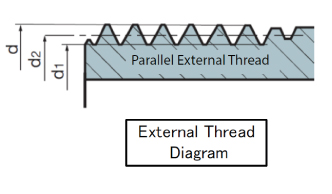
| External Thread Standard |
Former JIS PF 1/2-14 (Class A) |  |
Current JIS G 1/2-14 (Class A) | ||
| Basic Diameter | Tolerance | Basic Diameter | Tolerance | ||
| Major Diameter (D) |
20.955 | 0 | 20.955 | ~ | |
| -0.284 | -0.284 | ||||
| Pitch Diameter (D2) |
19.793 | 0 | 19.793 | 0 | |
| -0.142 | -0.142 | ||||
| Minor Diameter (D1) |
18.631 | 0 | 18.631 | 0 | |
| ~ | ~ | ||||
| External Thread Standard |
Former JIS PF 1/2-14 (Class B) | |
Current JIS G 1/2-14 (Class B) | ||
| Basic Diameter | Tolerance | Basic Diameter | Tolerance | ||
| Major Diameter (D) |
20.955 | 0 | 20.955 | 0 | |
| -0.284 | -0.284 | ||||
| Pitch Diameter (D2) |
19.793 | 0 | 19.793 | 0 | |
| -0.284 | -0.284 | ||||
| Minor Diameter (D1) |
18.631 | 0 | 18.631 | 0 | |
| ~ | ~ | ||||
 |
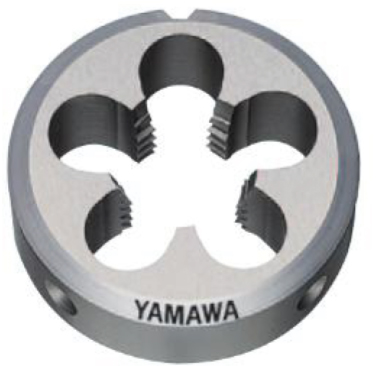
Although the YAMAWA Parallel Pipe Thread Solid Die (D PF) is designated with the "PF" thread symbol, it can be used for machining both: • PF parallel external threads • G parallel external threads Therefore, a single D PF solid die can be used for both PF and G external thread applications without requiring a different die. |
 One-Point Advice
PF and G parallel pipe external threads are designed to be used only with PF or G parallel pipe female threads.
They must not be used together with:
• PT or Rc taper pipe female threads
• PS or Rp parallel female threads intended for taper pipe threads
This is because these thread types are designed for different applications and are based on different thread standards.
As a result, they cannot provide the proper thread engagement required for a correct and reliable connection.
In summary: Although pipe thread designations can be confusing, selecting the correct thread standard is essential to ensure proper fit, sealing performance, and safe assembly.

Share on Facebook

Share on X

Share on Pinterest
Comment(s)
Recent Posts